
Creating policies, targets and KPIs
Summary
Developing sustainability policies is an iterative process, where broad commitments are refined into measurable actions and tracked for accountability. This is not always a linear process, as some policies, targets or KPIs might already exist, and some targets or KPIs might be immediately apparent whilst working on policies, whereas others take time and research to create. The availability (and outcomes) of baseline data will also help shape your ultimate policies, targets and KPIs. Adopting an iterative, layered approach can be very beneficial, allowing refinement as feasibility and data insights emerge.
This section outlines how to approach this, with a focus on how to actually generate the policies and associated targets and KPIs, and then to ensure they are feasible and achievable.
Creation flow
The diagram below provides an overview of this process and shows how the different steps can inform both following and previous steps. The best long-term results will come from PTKs that are not developed by the functional teams who will be responsible for their implementation, supported and facilitated by a sustainability team. The in-depth knowledge and understanding of domain areas, combined with expert sustainability and facilitation support, ensures policies are practical, enforceable, and drive real change.
Familiarising yourself with the steps and processes in the diagram will help frame this section and your understanding of the overall process.
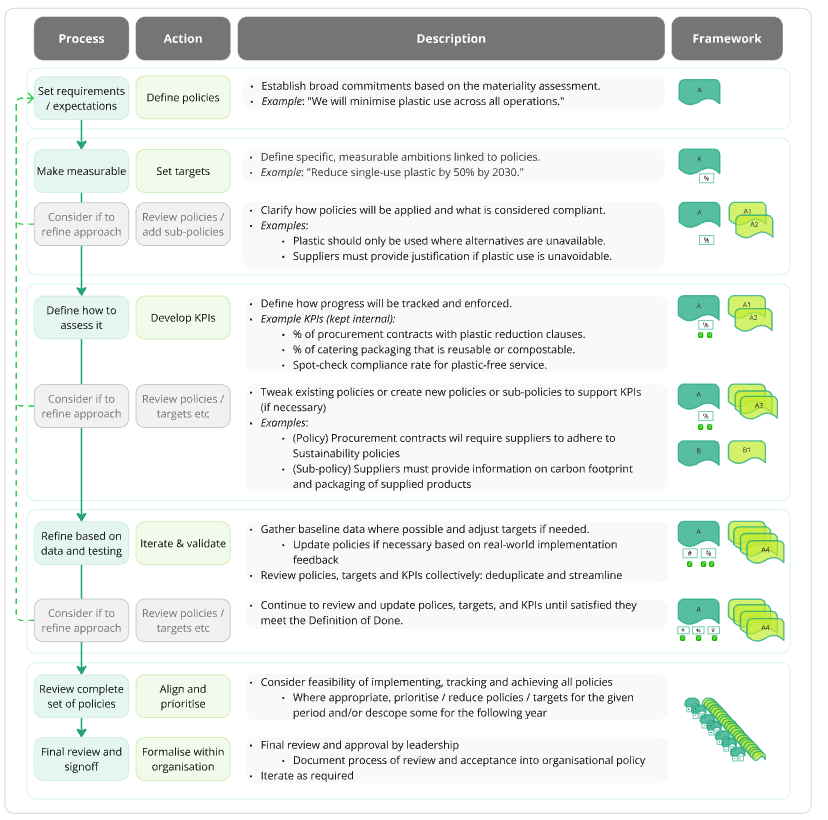
Iteratively create policies, targets and KPIs
Generate policy ideas
You will have done a lot of work during the definition of your vision and principles that can be used here. Using the structure you identified in the preparation phase, work with the relevant teams to review the topics that were identified as important in the materiality assessment and consider how they relate to the vision and the guiding principles. What actions, restrictions or commitments would be required to apply the principles to the issues?
For example, if you have the “Circularity in materials” principle mentioned earlier, and material analysis found that customers are concerned about food waste, then you may start to develop policies around reducing food waste, using module construction methods for temporary structures, and committing to donate unused office equipment.
Whiteboarding or interaction sessions can be helpful to drive engagement and generate ideas. For example, you might write the issues on sticky notes and then group by principle, or, write out the issues on the board and then suggest two or three commitments that would be required to achieve them.
Do not worry about creating too many ideas or policies, they can be reduced through iterative review and prioritisation as you progress through the process. As you develop your policies, and work through adding targets and KPIs, the policies will evolve and develop sub-policies. It is important to strike a balance with policies between being too vague (or weak) to be meaningful, or too strong (or stringent) to be realistic. A realistic policy will set clear direction, and also acknowledge operational realities (potentially through sub-policies).
Weak policy: "We encourage sustainable waste management."
Strong policy: "Single-use plastics are completely prohibited across all operations."
Realistic Policy: "We will phase out all single-use plastics by 2030", with sub-policies of: "Between 2025 and 2029 exceptions can be made on a case-by-case basis for health and safety or excessive cost grounds", and further sub-policies detailing the exemption criteria.
Make them measurable
Once you have a list of initial policies, consider how you would quantify the policy. For example, if you have a policy of “Minimise food waste”, a target might be “Reduce food waste to X kilos a month, or reduce food waste by Y% each year”. In thinking through the targets, you may decide you’d like to ‘divert z% of food waste to compost”, minimising waste and embracing circularity. This target could then prompt you to add a new policy around diverting all biological waste to compost.
A target can either be absolute (tap flow of less than 3.75litres/min, or no one than 1 tonne of material waste per 100sq meter of construction etc) or relative (reduce electricity usage by 10% per visitor, 30% of main meal menu items to be vegan). Whether targets are strong or not is contextual. Local and global guidelines (such as BREEAM, WRAP etc) can be useful, as can looking at the policies of other organisations or events that are similar to yours. If in doubt, it can be helpful to benchmarking approaches within your particular sector and/or region, and aiming to increase ambition based on what is currently possible.
Add indicators to assess them
Whilst the targets that you have quantified your policies with should be ambitious, they must be also be measurable through KPIs. This effectively means applying one or more ‘indicators’ to each target to be able to test and report on whether it is being met. Taking the food waste example, whilst there are high-tech solutions to recording what goes into kitchen waste, it is harder to measure in public-facing bins, especially where recycling is not being well adhered to. A waste contractor (or facilitates) should be able to tell you how many bags of biological mater are collected in a given period though, and they may even be able to tell you how many bags were contaminated (contained non-biological waste). A further consideration is whether the amount of waste should be relational to the amount of sales, or absolute.
For a policy to reduce food waste, with a target of 50% reduction, your KPIs may be something like the following:
- Weight of purchased ingredients in a given week / weight of organic waste collected from kitchen bins in same week
- Servings purchased / servings sold (i.e. ingredients purchase based on sales forecast vs actual sold)
- Value of sales from food prepared on site only / (organic waste bags collected from kitchen * estimated value of wastage in a bag)
Define the baseline data
Baseline data is information that tells us how we are performing against an indicator at the beginning of the period we want to measure. There can be a somewhat circular logic to baseline data; where it is available, it is helpful to use it to inform the process of shaping policies and targets, but often it is necessary to think through how to create indicators for a target in order to know what form the baseline data could take. The availability of data may then lead to a revision of the target to ensure it can be accurately measured.
Before finalising a KPI, it is important to check the availability and appropriateness of baseline data by acquiring an example of it. If calculations / manipulation of the data will be required, this should also be done as it will highlight any issues that may not be immediately apparent in the data. This is particularly important where KPIs are reliant on more than one data source (e.g. where they are relative) as there is more room for error.
Apply a feasibility test
By working collaboratively with each team area, resulting policies, targets, and KPIs should already be feasible. However, it is always helpful to have a final step review and ensure feasibility within the specific context of your organisation. Some (non-exhaustive) considerations may be:
Data availability
Do you have the internal procedures and external contractual arrangements in place to ensure the timely provision of the required indicator data?
Supplier flexibility
Are existing / new suppliers likely to be able to meet these requirements? Is there a potential cost implication?
Material / services availability
Where policies stipulate certain types of goods or services to be used, are they available (in sufficient quantity/quality) in your region? What are the lead times and cost implications?
Procurement
Do your contracts / procurement processes support these requirements? Can they be updated to ensure they do in future (i.e. require suppliers to provide necessary data; include penalties for failing to meet sustainability requirements etc)
Training needs
Do staff / suppliers / customers require additional information or capacity building to be able to meet these targets?
Operational impact
Is the resource / processes in place to support it? Does it affect more than one team, are all parties aware and onboard?
Enforceable
Are the policies enforceable? What happens if they are not met?
Phased change vs. immediate action
Can the policy be implemented now, or does it require transition planning?
Finance
Are there any potential costs and are they acceptable?
As part of the process, you may have reviewed the PTKs collectively to check for any conflicts or duplications, but if not, then this should be done before progressing to the validation and sign off phase. As the sustainability team will be across all the workstreams involved, they are best placed to undertake this process.
It’s important to note that not all policies need to be implemented in the first year or current period. It may be that there simply isn’t capacity, or that some policies (or targets) would benefit from others being implemented first. Having additional targets for policies, or complete policies (with associated Targets and KPIs) that aren’t “active” for the current period can help to support longer term sustainability goals, and also provides increased flexibility. For example, it helps with forecasting carbon reductions into the future and can also provide alternative options should one target not be achievable (non-conform), it may be possible to swap in another one (if your sustainability procedures for handling non-conformities allows it).