
Structuring policies, targets and KPIs
Summary
Translating your sustainability vision into meaningful action requires well structured, measurable commitments which have been well considered. Policies, targets, and KPIs (PTKs) provide this foundation, but creating them without a clear process, can risk producing vague, conflicting, or unworkable outputs.
It is strongly recommended to follow a three-step process:
- Prepare a framework for how you will structure and create them
- Undertake a collaborative process to create meaningful PTKs with the teams who will be responsible for delivering them
- Validate, refine, and sign off the set of PTKs you intend to deliver within your target period (i.e. your first year)
Different organisations may wish to adopt their own terms or ways of breaking down their goals, but for the avoidance of doubt, this guide uses the following:
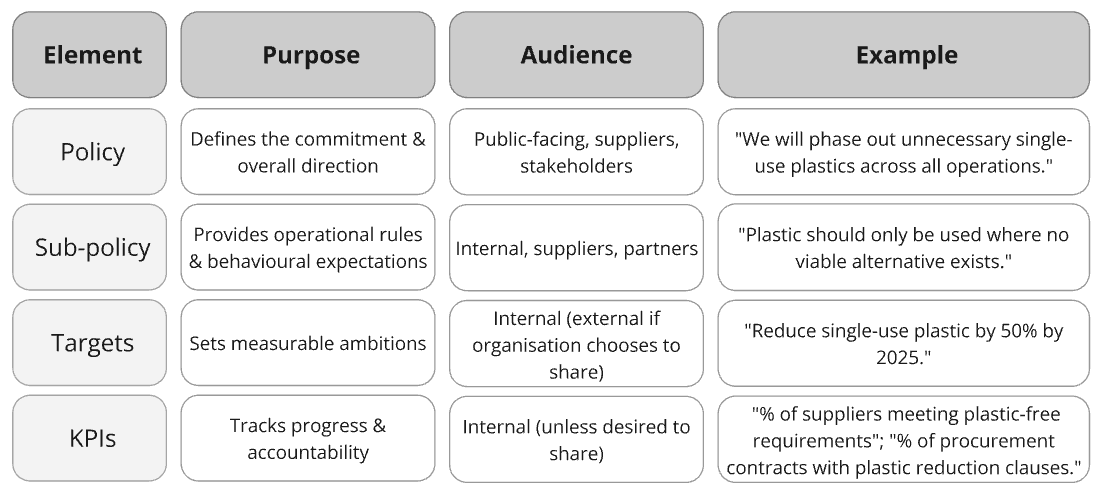
- Policies are rules or requirements that establish clear internal and external expectations to guide decision making and set accountabilities
- Targets translate policies into action through specific, timebound, measurable goals that define what the successful implementation of policies looks like
- KPIs track progress on specific matters, providing data to access targets against. This section will outline how to structure the process effectively, and provides practical guidance on developing a clear, achievable, and enforceable framework.
Structuring the approach
Regardless of how many people will be involved in the process, it can be helpful to create a document which outlines the approach that will be taken to shaping the PTKs for your sustainability strategy, taking into account the following considerations:
How will policies be grouped?
Consider how policies could align with existing teams and responsibilities, helping to ensure clear accountability and deliverability. This could be by function (e.g., Procurement, Operations, Transport) and/or by specific topics (e.g., Plastics, Energy Use, Waste Management). The approach may evolve as you start to identify policies and targets, but an initial firm foundation will greatly help.
Who will be responsible for which policies?
Identify policy owners early and clarify their role. For the best outcomes, policies and targets should be embedded through the teams responsible for implementing them, with sustainability teams supporting but not imposing. For example, the catering team may be best placed to take the lead on food waste reduction, while sustainability teams provide guidance and facilitation.
What are current levels of engagement and awareness
Assess whether teams understand the vision and sustainability commitments. If they were not heavily involved in developing the vision and principles, additional engagement may be needed to ensure alignment and buy-in. Consider whether teams have the necessary knowledge, skills, and resources to contribute meaningfully, and who may need more support.
Timeline and milestones
Develop a realistic timeline, mapping out which teams need to be involved at each stage, and communicate this in advance. Factor in time for consultation, review, and refinement. Allow for data collection where baseline measurements are not yet available.
Data and insights readiness
Consider what key information from the materiality assessment is available to support policy development, and what is lacking. While baseline analysis will take place later, consider what data will need to be gathered and factor this into the timeline – are there steps that can be taken in advance to support setting targets later.
Preparing templates
Are there standardised formats for policies, targets, and KPIs internally that could help to streamline the process. If not, could you create (or adapt) some for this process? Having structured templates helps maintain consistency and ensures policies are clear, actionable, and trackable.
Definition of Done (DoD)
What criteria should individual policies, targets and KPIs have to meet to be considered “Done”. In other words, what checks would they need to pass to ensure that the team responsible for implementing them, and the sustainability team, are satisfied the policies are comprehensive, and that individual components meet quality standards for clarity, completeness, feasibility, and ability to be assessed.
Ensuring relevancy to your organisation
With a plan for how to approach creating the policies outlined, it is also helpful to consider how to ensure the vision and guiding principles are interpreted inline with the purpose, values and structure of your given organisation:
Align policies with organisational function
Policies should reflect the unique sustainability challenges and opportunities of an organisation. While all organisations may need policies covering areas like energy, waste, and procurement, the focus and implementation will differ depending on the sector, and should be informed by your vision and guiding principles.
A venue might focus on enabling sustainable choices for attendees, with policies for:
- Encouraging low-carbon travel and providing public transport incentives
- Reducing event waste through clear bin systems and supplier requirements
- Sourcing sustainable catering, minimising food waste, and eliminating single-use plastics through service design
A consultancy might focus on embedding sustainability in its advisory work, with policies for:
- Ensuring all client recommendations include sustainability considerations
- Offering sustainability training to staff and external partners
- Reducing emissions from business travel and offsetting unavoidable impacts
A manufacturer might prioritise operational efficiency and supply chain impact, with policies for:
- Circular procurement — prioritising materials that are reusable, recycled, or responsibly sourced
- Reducing production waste and improving resource efficiency
- Phasing out high-impact refrigerants and monitoring emissions across sites
Policies should not exist in isolation; they should be designed within the operational realities of the organisation (and functional teams) who will implement them.
How do you intend to use the policies?
Your policies will define your organisational sustainability approach and ambition, providing not only a practical framework, but potentially an effective communication tool. Externally they can help set expectations for suppliers and stakeholders through providing a clear reference point for contracts and ways of working. In addition, they can signal your values, build transparency, and drive engagement with customers, partners, and the wider community. Sharing policies with suppliers gives them a clear understanding of what is required to align with your requirements and expectations, and facilitates their inclusion in contractual arrangements.
Internally, policies provide clarity, making it easier for teams to act. A well-structured policy removes ambiguity, ensures consistency, and helps people understand exactly what’s expected of them; moving sustainability from an abstract concept to something they can apply in day-to-day decisions.
It is recommended that organisations treat their policies as a powerful engagement tool, both for internal alignment and external transparency. This could take the form of full policies, select sections, or tailored versions for different audiences.
Defining policies, targets and KPIs
It is essential to define and use terminology consistently to ensure clarity and alignment. Some organisations may call targets objectives, or combine policies with targets, or targets with KPIs etc. Organisations should adopt an approach which aligns with how they already work. The framework presented here is a recommended approach for those starting from scratch:
Use of language
Language in policies should be precise and enforceable. Vague wording can lead to lack of accountability and inconsistent implementation. Consider using structured terminology like the MoSCoW method suggested below:

Utilising the same language in contracts and when assessing proposals from suppliers / contractors is helpful, as it provides clear assessment criteria and allows third parties to understand what is expected from them.
Documentation and fields to be collected
How best to document the PTKs will depend on your organisations way of working, and the breadth, depth and communication approach for your strategy. A higher-level strategy focusing on a few core areas may have the PTKs documented together, whereas a larger strategy with separate policy areas may have the policies together and the Targets and KPIs in one or more spreadsheets.
There is no one way to document PTKs, but it is helpful before beginning the process of defining them to map out the information you would like to collect for each.
For targets you may wish to collect:
- Name (shorthand name for the target)
- Summary (what the target is, potentially with a summary of key actions)
- Impact (High, Medium, Low)
- Achievability (High, Medium, Low)
- Level of ambition (High, Medium, Low)
- Constraints (potential challenges to implementation)
- Alignment (with vision – High, Medium, Low)
- Owner (responsible for data collection / achievement)
- Method of quantification (how will it be measured)
- Baseline (what it currently is)
- Baseline date (when this measurement was taken)
- Target value (timeframe and unit of measurement)
- Target date
- Status (on track, at risk, failing, unknown etc)
And for KPIs:
- Name
- Parent target (if not nestled together)
- What is to be measured
- Data source
- Data value (timeframe and unit of measurement)
- Who will provide the data
- When they will provide it
- Last result
- Status (active, delayed, missing, refused etc)
Event specific policy considerations
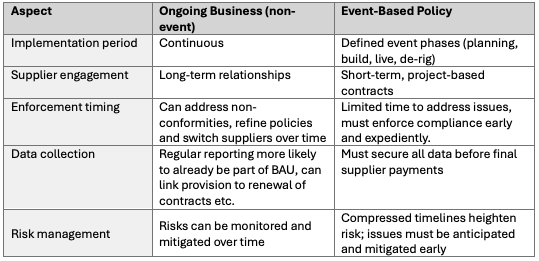
There are also some event specific considerations. Whilst the fundamental approach to policy creation remains the same, event-based policies must account for the fixed-nature and distinct phases of an event. These can require specific (or expedited) mechanisms to ensure compliance before, during, and after the event.
Event phase-specific policies
As events have distinct phases, they may have distinct PTKs for those phases. This is for a number of reasons including the level of control and services provided at the event site for that specific event in different phases. During live the event organisers may bring in caterers or additional power provision, and so create PTKs for these, but not have them outside of the event period. As the build, live and de-rig periods may have different levels of activity (and control), and resultingly different amounts of PTKs to be monitored, the assurance processes during these phases may also be different
Defining ambition
In this context your level of ambition relates to the volume and impactfulness of the goals your strategy will set out to achieve in a given timeframe. This should be grounded in the organisational motivations and priorities identified in Phase 1: Foundations, and take into account the available time, resource and political capital to achieve change.
It is important to note that environmental standards are likely to require you to be able to justify your level of ambition (e.g. ISO20121) or as a minimum, be able to demonstrate they your objectives reflect your environmental risks and impacts (e.g. ISO14001). If you are following a standard it is also likely that you will be required to meet the targets you set, and where you are unable to, have a process for addressing “non-conformities” (PTKs not being met).
One approach that can help to strike a balance between setting ambitious goals to drive real change, but without over-committing, is to have a scaled approach to your goals. This means categorising your goals (PTKs) by their level of ambition (or potential impact) and then setting targets for how many of each you would like to achieve. This encourages teams to strive for more ambitious outcomes, without fearing of repercussions if there not achieved, whilst allowing an organisation to balance it’s available resources to achieve the most likely ambitious goals across the orgsnation (or event.)
Categories of ambition:
- Low ambition (or “foundational measures”): essential actions you must take to meet a basic level of overall sustainability.
- Medium ambition (or “impact measures”): aspirational actions that position your organisation or event as a leader in your sector or region.
- High ambition (or “transformational targets”): highly ambitious actions that push boundaries, raise sector-wide ambition, and create lasting impact. These may require significant buy-in and are typically achieved incrementally.
- 100% of foundational targets.
- 50% of impact targets for each workstream.
- 20% of transformational targets across the organisation as a whole.