Stakeholder engagement
3.2 Stakeholder engagement
The discovery stage will have given you a good understanding of your organisation and the context that it operates in. It will have also furnished you with a broad, high-level understanding of the main sustainability considerations for your organisation and introduced you to many of the relevant stakeholders throughout the organisation.
The next step is to create and implement a plan to identify key stakeholders, determine which are most central to achieving your strategy, and subsequently gather their views on which sustainability issues matter most, in addition to the challenges they may face and opportunities they see. This is a comprehensive process which takes some time to complete properly. However, it is one of the most important steps in creating an effective and impactful strategy and can help build lasting beneficial relationships with stakeholders.
3.2.1 Internal engagement
As sustainability relates to every aspect of an organisation, it is most effective when it is delivered as an integral part of the operation of each element of the organisation. To start to build early internal engagement and buy-in, it is highly recommended (but optional) to have an organisation-wide ‘sustainability workshop’ between completing discovery and beginning stakeholder engagement. This session is an opportunity to:
- introduce the wider organisation to the sustainability function
- provide training and establish a baseline of understanding around what is meant by sustainability and carbon management
- present back key findings around sustainability in your sector (and/or organisation currently)
- have interactive engagement sessions to collaboratively start to workshop what some sustainability considerations are that are important to your colleagues, your customers/attendees, suppliers, and more widely as an organisation
- present a timeline for the development of the sustainability strategy, outlining the role that teams will play in shaping and implementing the strategy
- have a senior stakeholder speak at the session to endorse the approach and emphasise its importance to the organisation
It is a chance to start the organisation thinking of sustainability as something they have agency for, and to signpost the involvement that will be required later on. This session can set the tone for an interactive, collaborative process, where the organisation works together to deliver sustainable outcomes.
3.2.2 Stakeholder identification and mapping
Stakeholders are people or organisations who will either impact or be impacted by your organisation. This typically includes:
- suppliers
- your workforce
- your customers/service users
- regulators
- investors (or sponsors)
- the community in which you operate
It is up to individual organisations to define who they are, but inclusions/exclusions should be justifiable.
Stakeholders are best identified through a collaborative process where the sustainability team works with each department/team to map out the people/organisations who are relevant to the operation of their remit areas. To help with this, the sustainability team can create a template (and pre-populate it where possible) in advance, and come prepared to lead the session in an interactive, supportive way. Try to avoid undertaking this process over email, as it may lead to the templates being filled out by only one team member or in a cursory way, resulting in stakeholders being missed.
Aim to map out all of the stakeholders who you (as an organisation) have repeat interaction with. Where a stakeholder is a group rather than a given individual or organisation (for example, customers, community, or even suppliers for goods where you don’t have regular sources), identify representative examples of the group. For larger groups (such as customers) it is helpful to identify sub-groups based on personas and/or needs.
3.2.3 Which stakeholders to contact
It is neither necessary nor practical to engage with all stakeholders, so you will need to define which are most relevant to your organisation and your sustainability strategy. The way this is approached will strongly influence the outcomes and should therefore be shaped by your organisation’s values and objectives for your strategy. Typically, this is approached by assessing:
- Their relationship to your organisation: how closely they are involved in, or impacted by, your activities
- Their ability to impact outcomes: how much direct or indirect influence they have over the potential success of your strategy
Some examples of methods for stakeholder categorisation and where they might be used are:
- Interest & power: in corporate settings or those with existing strong governance structures, assessing how interested stakeholders are in sustainability efforts and their power to influence or lead decision-making
- Importance & influence: in compliance-driven contexts, ensuring key decision makers, regulatory stakeholders, and those whose opinions most influence external perceptions are engaged, to ensure meeting industry standards and/or legal requirements
- Relevance & impact: for strategies with a focus on the most meaningful sustainable outcomes, ensuring the views of those most affected are weighted appropriately
- Centrality: a simplified approach, ranking stakeholders based on how closely related they are to achieving sustainable outcomes
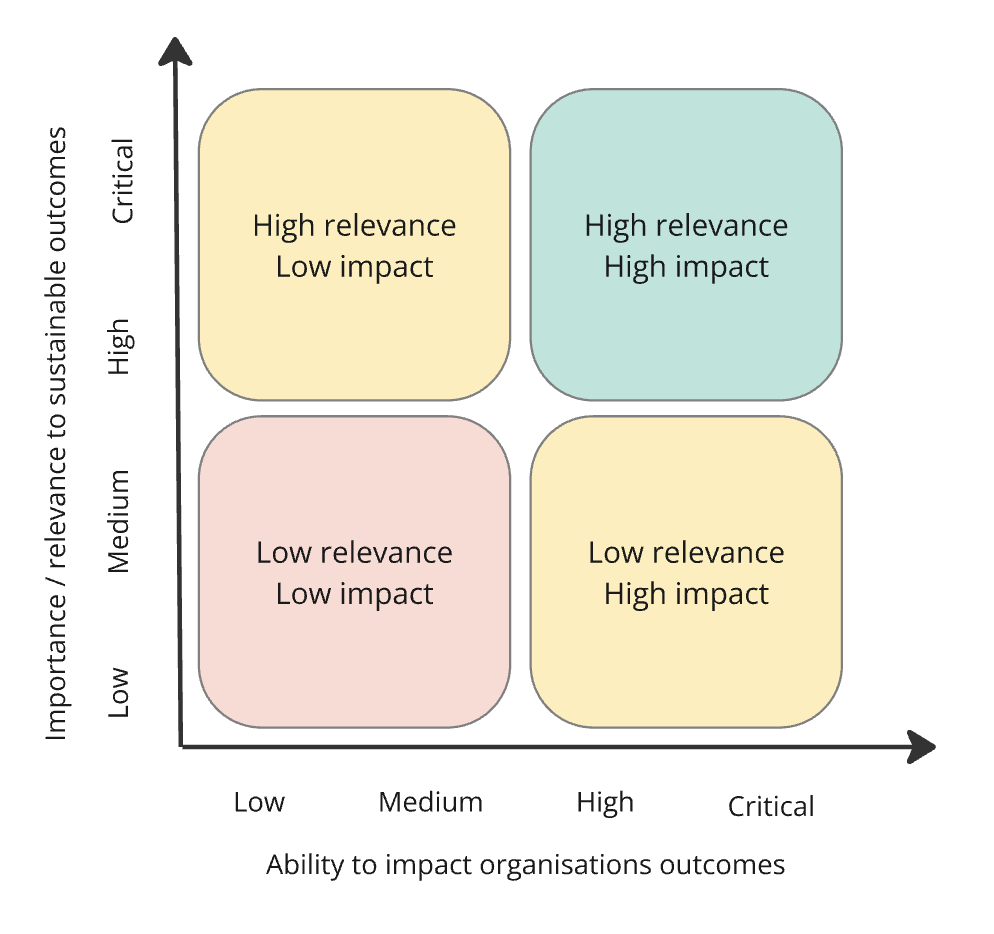
Once you have categorised stakeholders, you will have a clear view of which are the most central to your strategy, and an understanding of how many fall into each of your categories, which will in turn inform your approach on who to contact and how.
3.2.4 How to contact stakeholders
There is no set way to contact stakeholders, but typically one or more of the following methods would be used:
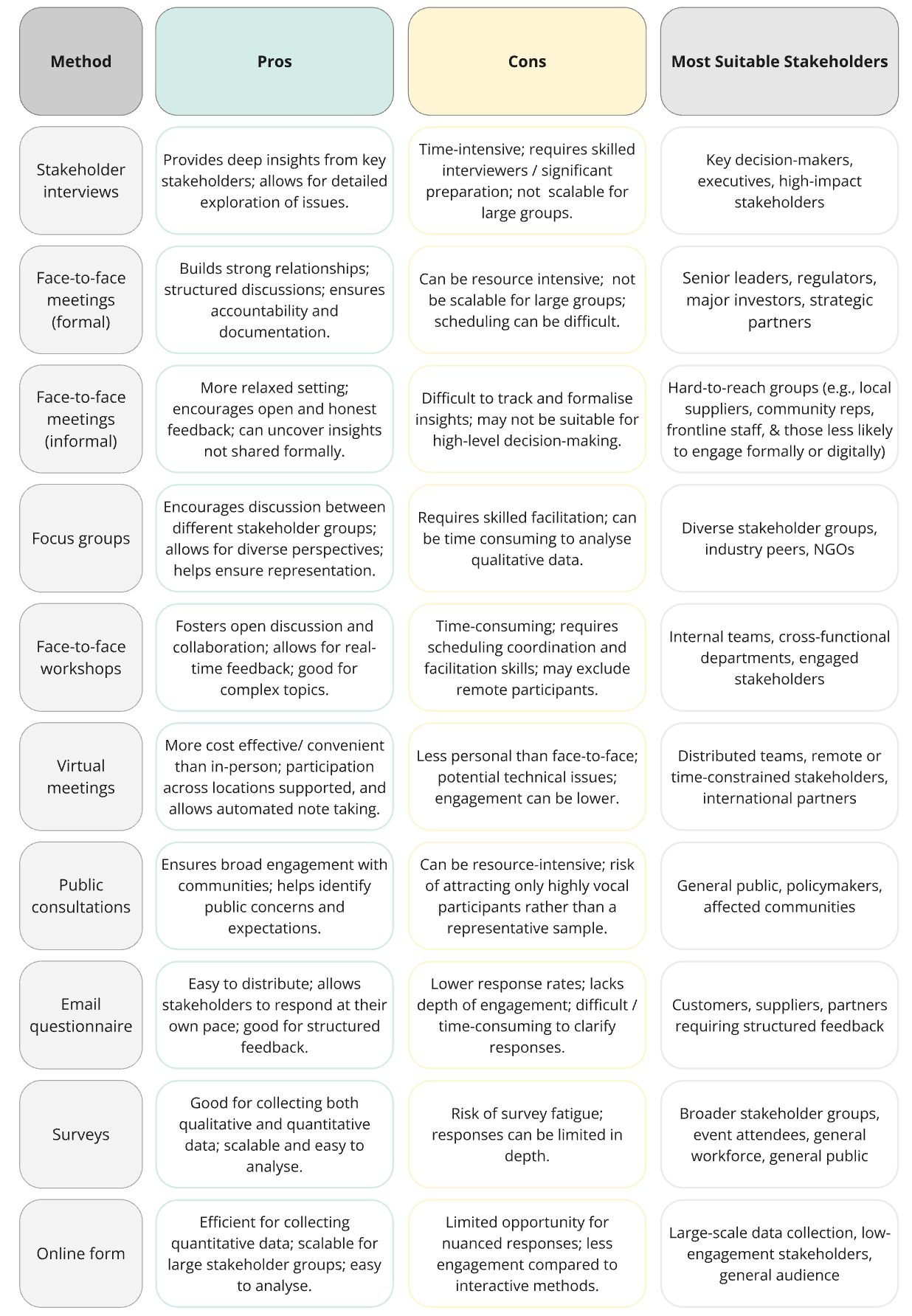
It is important to tailor the approach to your stakeholders, and the specific context of your organisation. It should be noted that the approaches taken will impact the data received, and the level of engagement and buy-in that those stakeholders will have going forwards. Particular attention should be paid to accessibility considerations to ensure that the process is inclusive.
The most effective way to engage productively with stakeholders depends on a range of factors, including the size of their organisation; its importance to your organisation (and vice versa); their seniority; cultural norms; the relationship with the individual or organisation; and their communication preferences. By collaborating with your internal teams to identify stakeholders, you can leverage the knowledge of those who understand them best.
You will also need to factor in time constraints, taking into account the size of your team and available time to complete the stakeholder engagement phase and subsequent analysis of the data. You may wish to adopt an approach which has a ‘hierarchy of granularity’, where the amount of time invested in gathering feedback, and the balance between gathering qualitative and quantitative data, is proportional to the relevance/impact of the stakeholder.
3.2.5 What fields to collect when stakeholder mapping
The fields to collect will be determined by your overall approach but should include information on who the individual/organisation is, their relationship to your organisation, how best to contact them, and what their contact details are. For example:
- Organisation
- Stakeholder role (i.e. CEO, Sales Director, Consumer)
- Importance (how important are they to your organisation/event)
- Impact (what impact could they have on your organisation’s ability to achieve its targets)
- Relation to your organisation (i.e. supplier)
- Stakeholder name
- Stakeholder contact details (email, phone, etc)
- Most effective method of engagement (in person, virtual meeting, email, form)
- Relationship owner (who is their primary contact in your organisation)
- Communication frequency (how often you should update them on their views)
3.2.6 How to create questions for stakeholders
Determining which questions to ask stakeholders may seem daunting at first, as you won’t yet have a full sustainability strategy to guide you. However, this is completely normal, and a large part of why this process is so valuable. By considering your organisation’s purpose and values, the rationale for creating the strategy, insights through the discovery process and stakeholder identification, you can build a clear picture of what information would help inform your understanding and shape your strategy.
There may be a set of general questions you would like to ask to establish a baseline understanding of views and perspectives across your stakeholder groups. These can be complemented with more tailored questions for different types of stakeholders (e.g. suppliers, customers/attendees, community groups, employees, etc.) to ensure you are asking the most relevant questions to the right groups.
A useful format to follow is:
- Define what you need to understand from stakeholders
- Create a mix of baseline and tailored questions
- Hypothesise potential responses (and test internally or externally if possible)
- Review and revise the questions
- Conduct engagement in phases (to manage workload and allow adjustments)
- Refine as needed (without compromising data comparability)
Some further considerations to help design your questions:
Designing effective questions
- Avoid leading questions; keep wording neutral to prevent influencing responses
- Use balancing questions; for example, if you ask about challenges, also ask about opportunities, or if you ask how a factor (such as sustainability) impacts decisions, ask what the other considerations are they must balance this against
- Consider when to use open vs closed questions; closed questions (yes/no, multiple choice) are more comparable, while open questions provide deeper insights but require more time to process and categorise; a mix is ideal
- Avoid assumptions in questions; instead of “What improvements would you like to see in our sustainability strategy?”, ask “How do you currently perceive our sustainability efforts?”
- Make sure questions are actionable; will they solicit responses you can act on or use to inform your strategy?
Practical considerations
- Consider stakeholders’ level of investment and available time; keep questions concise for less-engaged groups, while allowing for depth with key stakeholders
- Similarly, consider how long each category of stakeholder is likely to be able or willing to spend answering questions, and tailor the number and mix of qualitative/quantitative questions accordingly
- Match the question format to the engagement method; consider how responses might differ in an email vs a workshop vs a survey
- Provide a short introduction; explain why you’re asking the questions to give context and encourage engagement
- Allow for the natural tendency for people to suggest solutions rather than state underlying problems; structure questions in such a way to discourage this in more linear engagement formats (email, online forms, etc.), and be prepared to ask follow-ups to uncover root causes in workshops and meetings
Implementation & Data handling
- Ensure data security and confidentiality; check for any sensitive, business-critical or non-public information in your questions or introduction
- Allow space for unexpected insights; include an open-ended question like “Is there anything else you’d like to add?” to capture responses you might not have anticipated
3.2.7 What types of questions to ask stakeholders?
It is important that organisations define their own questions based on their specific context, purpose and objectives. To help with this process, some example questions are provided below to illustrate the different types of question that can be asked. These examples will also show how the motivations for creating a strategy will play into the formation of the questions, and how an individual question can be used to gain understanding on a number of considerations at once.
Example question: What does a sustainable [organisation / event…] look like to you?
- Stakeholder group: All
- Question type: Qualitative
- Answer format: Open text
- Rationale: Open ended question to identify themes and priorities through key words, and how they differ between stakeholder categories. This gives a high-level picture of the sustainability maturity (depth of understanding and engagement) among your stakeholders, and how perceptions and expectations may differ between groups.
An alternative way to ask the above question would be to ask what other organisations/events (similar to yours) the respondents have experience of that they consider sustainable, and what it is about them that makes them sustainable. This would give responses aligned on expectations arising from current practice, rather than a respondent’s personal views. If the motivation of the strategy is to ‘keep up with competitors’ in terms of sustainability, then this would be a good approach.
Example question: What percentage of your current products have you performed a Life Cycle Analysis (LCA) or Social LCA on?
- Stakeholder group: Suppliers
- Question type: Quantitative
- Answer format: LCA: __% / SCLA __% / Intend to or would be open to start assessing within next year / None and no plans
- Rationale: This gives concrete information on how many products an individual organisation has data for, and indirectly tells you:
- how feasible it would be to collect LCA data from suppliers in year one
- whether they are open to start assessing their products
- how far along they are on their sustainability journey they are (as opposed to, say, asking “How important is sustainability to you?” without asking for examples of actions taken)
The above question would be most suited to a supplier who manufactures their own products. For a reseller you could ask what percentage of their products they are able to provide the carbon footprint and/or environmental impacts of their products instead. This information helps you understand the ease or difficulty at which you will be able to source sustainable goods from your current suppliers, but also potentially starts to nudge your suppliers towards considering and improving their own environmental approach. Following up with suppliers who said they would be open to start assessing with some advice on how to proceed could benefit you both and strengthen the relationship. Conversely, it should be considered that suppliers may worry about their contracts if they find themselves answering negatively to a number of these questions, so the format and accompanying explanations should be well thought through.
Example question: Would you/your organisation be interested in joining sustainability training sessions, and if so, what topics would you like them to cover?
- Stakeholder group: Any – depending on motivation
- Question type: Qualitative or Quantitative
- Answer format: Yes / No / Free text or multiple selection
- Rationale: This question both informs you of willingness to join training, but also helps to show the areas of sustainability that stakeholders are less confident and/or most interested in learning about. Where sustainability maturity is expected to be low (or you have specific needs/interests) consider giving a multiple selection to guide the answers and avoid respondents putting the topics they know rather than those that might help them the most (but they don’t necessarily know to raise).
The purpose (and therefore targeted stakeholders) of this question can differ depending on your motivations for the strategy. For example, if sustainability is an important part of your brand proposition, then you may offer to do training sessions/webinars for interested customers to effectively promote your brand. If your organisational values are to ‘benefit the wider community’ then you might be motivated by educating and collaborating with the wider (consumer/regulator and/or supplier) community. From a purely practical perspective, there are many operational benefits to working with supplier/partner organisations to collaboratively develop knowledge and skills, especially where you are looking to track and report on environmental impacts.
Example question: How important do you feel sustainability will be to our organisation’s success in the next ten years, and how central to this do you feel you/your team are?
- Stakeholder group: Internal employees
- Question type: Quantitative and Qualitative
- Answer format: (As one or two questions (you/your team)) Select from 1 (no impact) to 10 (critical to success) // Free text
- Rationale: This question is intended to gauge internal opinions on how sustainability aligns with business objectives, and the extent to which individuals see themselves, and/or their teams, as having accountability for making the organisation sustainable.
This sort of question can help map differing perspectives within the organisation, and highlight the cultural change work which may (or may not) be required to create an environment conducive to achieving sustainable outcomes. Including space for additional free text comments can potentially reveal valuable insights as people consider sustainability from their perspective within the organisation. The outcomes of this question can also help inform the sorts of training (and/or KPIs around internal awareness and engagement) that could benefit your overall strategy.
Example question: Sourcing sustainable materials can increase production costs. Would you be willing to pay more for a product that was net-zero (and/or sustainably sourced)?
- Stakeholder group: Customer
- Question type: Quantitative and Qualitative
- Answer format: Free text // Multiple choice (e.g. +10%, +30%, +50% etc)
- Rationale: This question aims to explore customer willingness to pay a premium for more sustainable products. The free text entry allows customers to express attitudes towards where the responsibility for sustainability costs should sit; additionally, it can help you understand how motivated customers are by sustainability considerations.
Alternative approaches to gathering customer feedback on sustainability would be to ask broader questions such as:
- What areas of sustainability are most important to you and how do they influence your purchasing decisions (or experience of an event)
- How sustainable do you feel our [product/events] are, and how does this influence your purchasing decisions/decision to attend
3.2.8 Timing and phasing of stakeholder engagement
If time allows, you may wish to test your questions with a small subset of stakeholders to assess how effectively they work, and whether you would like to make any adjustments before going out to the wider group.
Depending on the volume of stakeholders, you may also wish to structure engagement in phases based on weighting, stakeholder categories, or by department, etc. This helps distribute the initial workload, staggers data collection, and makes the overall process more manageable. Phasing will also allow for course correction if any questions are misinterpreted, or if early feedback identifies new areas you would like to explore further with the remaining audience.
3.2.9 A note on standards
In terms of standards, ISO14001 requires you to identify ‘relevant parties’ but does not specify who they should be. ISO20121 is more prescriptive, and says identification ‘shall, where applicable’ include the event organiser, event owner, workforce, supply chain, participants, attendees, regulatory bodies and the community. GRI Standards take this a step further, requiring organisations to disclose who was engaged, how, and how their input influenced decisions. Stakeholder engagement should help define sustainability ‘material topics’.
These standards all require evidence of initial and ongoing stakeholder engagement, so it is recommended to consider how best to approach and track this at the initial stakeholder engagement stage. The database/spreadsheet that you create when identifying them could be used to record subsequent engagements or note where to find evidence (i.e. in a CRM system, email threads of particular team members, regular meeting/contract review notes, etc).